
Houston Bike Plan Proposes New, Safer Bikeways for Our Neighborhood

Attention: Public comments are needed on the draft of the Houston Bike Plan by April 11th, 2016! Please read the below for more information.

Please enjoy the below article by guest write Robin Holzer, a Montrose resident and active transportation advocate with Traffic Engineers, Inc. The Houston Bike Plan needs your input – see details and links within the article.


Bicycling in Houston is fantastic, except when it isn't. That's because less than half of the City's bikeways are high-comfort facilities. We enjoy 259 miles of high-comfort trails and the occasional protected bike lane, but they don't connect to one another. The other half are often just "share the road" signs and sharrows on wide, high-speed roads.

Despite stressful and fragmented facilities, the number of people moving about our city on bicycle keeps growing. The bike share system is expanding, bike connections on METRO keep growing, and more people of all backgrounds are riding in events like Tour de Houston and Critical Mass. It's time to make pedaling in Houston safer.


In 2015, the City of Houston opened the Lamar Cycle Track, the City's first two-way protected bike lane:

BikeLane1.jpg
BikeLane2.jpg

In February, the City of Houston put forward a new plan that was developed in cooperation with the community, BikeHouston, the Houston Parks Board, H-GAC, and TxDOT.

Review the draft network at HoustonBikePlan.org and share your thoughts before April 11, 2016. The Houston Bike Plan envisions a well-connected network of low-stress bikeways for people of all ages and abilities. The big idea is to make Houston a safer, more accessible, Gold Level Bicycle Friendly City by 2026.

HoustonBikePlan.png

Example of a Protected Intersection

Example of a Protected Intersection

The plan lays out the approaches necessary to make it happen, and includes:

  • 121 miles of Programmed high-comfort bikeways that are already funded,
  • 249 miles of Short Term high-comfort bikeways that can be achieved through modest investments like restriping street and adding wayfinding signage on low-volume, low-speed streets,
  • 86 miles of Key Connection projects to link neighborhoods and activity centers to a city-wide network,
  • 861 miles of Long Term projects to be developed over time as streets are reconstructed, and a
  • Bicycle Toolbox with comprehensive approaches and recommendations for the design of bikeway projects, a policy framework, and programs to educate and encourage more people to bike.

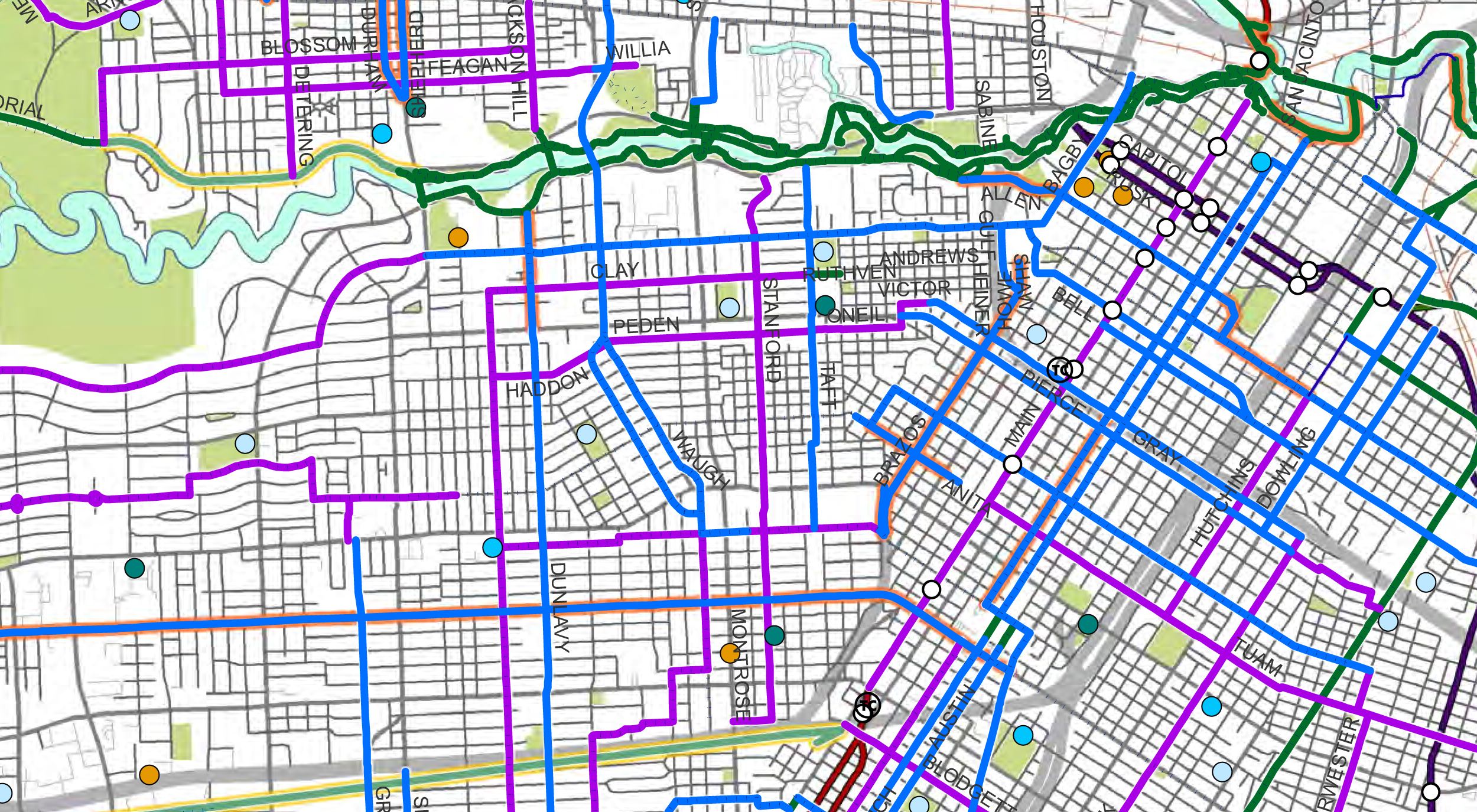
The map excerpt below shows short-term bikeways proposed for our neighborhood. I especially appreciate new dedicated bike lanes to connect Taft, Waugh, and Dunlavy north to the trails along Buffalo Bayou. Visit HoustonBikePlan.org to see all the maps and share your thoughts.
– Guest post by Robin Holzer

City of Houston Zika Virus Announcements

The below content is directly copy/pasted from emails from the City of Houston. We recommend that you sign up to receive these, and emails like these, by going to this address:

http://cohapp.cityofhouston.gov/citizensnet/


ADDRESSING CONCERNS REGARDING THE ZIKA VIRUS

The City of Houston is taking the Zika Virus very seriously. The Houston Health Department held a planning meeting on January 29th with Harris County and our regional partners, including blood banks, healthcare providers, petrochemical companies, mosquito control specialists, and others to begin developing plans for pre-emptively preparing for and preventing the transmission of Zikavirus in the Houston-area. The City will continue coordinating with regional, state and federal partners to prevent the virus.

The virus is transmitted to people through the bite of an infected Aedes species mosquito. The infection is usually mild, lasts from several days to a week and includes fever, rash, joint pain and conjunctivitis (red eyes). Severe illness requiring hospitalization is uncommon, but there may be serious complications for pregnant women.

This week, the World Health Organization (WHO) declared the Zika virus an international emergency and public health officials are considering barring patients who have traveled to affected areas from donating blood for up to 28 days.

How do we stop the spread of the virus? 

  • Remove ALL mosquito breeding opportunities around your home by eliminating all standing water, or items that may hold water.
  • Use air conditioning or window/door screens to keep mosquitos out.
  • If you are traveling to Central or South America or the Caribbean, it's important to prevent mosquito bites.
  • Use insect repellent that contains DEET.
  • Wear long-sleeved shirts and long pants.
  • When you return home, continue using DEET containing insect repellent for two weeks.

For more information on the Zika virus in our community, pregnancy tips, and travel alerts visit: 
http://www.houstontx.gov/health/Epidemiology/Zika_Virus.html  

Frequently Asked Questions can be found here: 
http://www.houstontx.gov/citizensnet/zikavirus-qanda.pdf


FOLLOW-UP FROM THE CITY OF HOUSTON SENT MONDAY, FEBRUARY 15, 2016

City of Houston Begins Trash Roundup to Reduce Mosquito Breeding Grounds, Combat Zika

As part of Mayor Sylvester Turner's Zika Virus response plan, the City of Houston Solid Waste Management Department has started a comprehensive citywide cleanup of illegal dump sites and collection of heavy trash to help reduce mosquito breeding sites.  The special collection sweeps will occur on Saturdays for the near future. Normal junk waste collection will proceed per the regular schedule.

Residents can help by doing the following: 

  • Eliminate all standing water from their property.
  • Remove all trash because mosquitoes can breed in areas as small as a water bottle.
  • Make sure to empty water from discarded tires and separate them from the rest of your junk waste pile at the curb to allow the SWMD employees to properly sort the materials.
  • Report illegal dumping sites by calling 311.
  • Utilize one of the six Neighborhood Depository/Recycling Centers listed below to dispose of heavy trash if you miss the collection date in your neighborhood.

Northeast: 5565 Kirkpatrick
Northwest: 14400 Sommermeyer
North: 9003 North Main
Southeast: 2240 Central Street
South: 5100 Sunbeam
Southwest: 10785 Southwest Freeway 

For more information about the City of Houston Solid Waste Management Department and its services, please visit us at www.houstonsolidwaste.org, like us on Facebook athttp://www.facebook.com/houstonsolidwaste, follow us on twitter @houstontrash or call 311, the City of Houston's Customer Service Hotline.

Houston Tomorrow's Vision Zero Plan

VisionZero.png

Houston Tomorrow recently published a report called Vision Zero: Toward a Vision Zero Action Plan for the City of Houston. This report outlines their recommendations for eliminating traffic-related deaths and injuries across all modes of transit – motorists, cyclist, and pedestrians.

Read the full report by clicking here.


This comprehensive report is well-worth a read, and outlines how we can reduce the 13-County Houston traffic deaths from 667 per year to zero per year over the next decade. This number doesn't even include the several thousand of incapacitating injuries, or the even higher number of total crashes – most of which are completely preventable. Many cities worldwide and across the nation have Vision Zero reports, including other "car" cities such as Los Angeles. With the recent hit-and-run pedestrian death at Taft and Westheimer, this is something that affects all neighborhoods of Houston, including ours.

The report dives into initiatives that are already working hard for Houston such as Complete Streets, and also outlines several concrete ideas for how we can reduce traffic deaths and make streets safer. The over-arching strategies include the below four points, but again, there are many tactical methods of implementation outlined in the plan as well:

  1. Proper metrics of safety and usage, which accurately identify problem areas and track progress toward program goals.
  2. Education and enforcement of existing policies and laws.
  3. Introducing new policies and laws and enhancing existing ones to make conditions safer.
  4. Re-examining the underlying built environment and taking steps to reconstruct it to meet the safety needs of all users.

Please take 15 minutes to read the report as it's certainly a conversation worth having and plugging into.

– by Caroline Garry, with thanks to Kay Warhol for providing the tip!

36 Hours in Houston: A New York Times Article

36HoursInHouston.png

Houston was recently featured in an article in the New York Times called 36 Hours in Houston, with Montrose (and places right by Winlow) featured – making us very proud. Featuring Common Bond, the Menil, our local antique shops and much more. It's a great read if you want to re-love this great city, or if you're entertaining out-of-town guests. Read it here.

– many thanks to Lindsey Aldrich and Ben Garry for the tip

24-Hour Pothole System

According to a recent announcement by the Mayor's office, starting in mid-January, potholes that are properly reported to the City's 311 Help and Information System will be assessed and addressed by the next business day. The goal is to effectively, efficiently and safely repair each reported pothole within a 24-hour period.

Per Council Member Ellen Cohen's City Hall Update, "the City of Houston has achieved a 97% success rate since the launch of the program despite a 1,000% increase in pothole reports. In the period from January 4th through noon on January 22nd, 1,212 citizen-reported potholes were filled by the next business day (including approximately 250 in District C) and 2,827 potholes were filled proactively by the Public Works and Engineering Department." The progress of the Pothole Program can be tracked atwww.HoustonPotholes.org.

Please contact 311 to report potholes by:

– information provided by the City of Houston